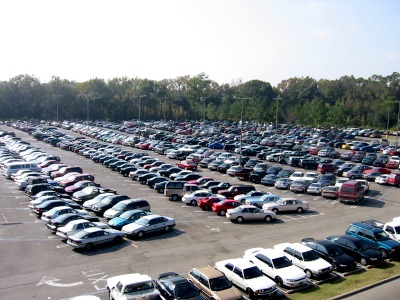
The reek of desperation among the automobile manufacturers is palpable. "Free" financing has been a staple of auto enticemnents for years, now dealers are promising "free" gas, or some convoluted scheme to guarantee future gas price for increasingly desperate customers.
I wonder if the future of the oil/car pushers will be modeled upon a one-time fantasy of the computer industry. It was once opined that the price of computer hardware will fall towards zero and the profits for suppliers will be realized through the sale of software. This has been a pipe-dream of the computer industry, as it's seen now that almost the opposite is true. The price of Macs keeps going up, yet a company like Google can provide a number of useful applications for free.
Will we soon see advertisements offering a free car with the purchase of gasoline?
It wouldn't surprise me, as nothing does anymore.
Wednesday, July 2, 2008

Thursday, June 26, 2008
Who Pays?
A local bicycle rider has written:
“Every spring I hear the same two complaints from motorists. Cyclists don't follow the rules of the road, and they do not pay to use them.”
Leaving aside the first complaint for the moment, I had some thoughts about the second.
The counter-argument to the false idea of “my taxes pay for the roads” are many. The simplest one is that taxes are taxes and everybody pays them. Saying that this kind of tax is earmarked for that kind of program is a false argument. Its like saying I can’t pay you the $20 dollars I owe, because its in my left pocket....
--Sure I have the $20, but its in my left pocket and that’s for something else.
--See, my right pocket is empty.
--If I had the $20 to pay you, it would be in my right pocket....
It’s all about priorities.
The most elegant one is that if everybody rode bicycles [by using the word “bicycle”, generally I mean any self-propelled, lightweight, emission free vehicle], we’d likely never have to build another road. Ever. Think about that for a moment.
Well maybe that is an exaggeration, but maintenance budgets would drop to a quarter or a tenth of current levels. In the absence of free and easy (read subsidy and society-enabled) motor vehicle traffic, we have already built every road we are likely to ever need.
Ten thousand cyclists a day passing over any given piece of road for a hundred years will not equal the damage done to roads that a year’s worth of motor traffic will inflict.
Currently, the motorist ensures he will be paying high taxes simply by being a motorist. Most car owners have never even considered how much society subsidizes their “right” to drive.
A sane system would demand the demonstration of “cause for use”. In the short term, this would allow a road user such as a contractor who absolutely requires a vehicle to still make a living. But the single use motor driven commuter would no longer be a viable option. It is ridiculous how we preserve some of the most expensive real estate in Canada for keeping our cars happily waiting for us at the end of an office-bound day.
Getting people out of personal use cars will free traffic gridlock and allow once again the efficient use of roads. Dedicated routes could then be maintained for heavy and light truck/service traffic along commercial routes. Other routes would be exclusively for transit--maxi and mini buses, and clean-air taxis. Still others would be dedicated to bicycles. Many neighbourhood streets would gratefully succumb to depaving.
By creating separate traffic streams, one of the three major impediments to getting people out on bikes is removed, as conflict with motorised traffic is limited to infrequent intersections. Imagine how quickly you could get from SFU to ScienceWorld if you only had to stop at lights at Willingdon, Boundary and Main streets, with the Boundary overpass coming online next year!
It’s all about priorities.
“Every spring I hear the same two complaints from motorists. Cyclists don't follow the rules of the road, and they do not pay to use them.”
Leaving aside the first complaint for the moment, I had some thoughts about the second.
The counter-argument to the false idea of “my taxes pay for the roads” are many. The simplest one is that taxes are taxes and everybody pays them. Saying that this kind of tax is earmarked for that kind of program is a false argument. Its like saying I can’t pay you the $20 dollars I owe, because its in my left pocket....
--Sure I have the $20, but its in my left pocket and that’s for something else.
--See, my right pocket is empty.
--If I had the $20 to pay you, it would be in my right pocket....
It’s all about priorities.
The most elegant one is that if everybody rode bicycles [by using the word “bicycle”, generally I mean any self-propelled, lightweight, emission free vehicle], we’d likely never have to build another road. Ever. Think about that for a moment.
Well maybe that is an exaggeration, but maintenance budgets would drop to a quarter or a tenth of current levels. In the absence of free and easy (read subsidy and society-enabled) motor vehicle traffic, we have already built every road we are likely to ever need.
Ten thousand cyclists a day passing over any given piece of road for a hundred years will not equal the damage done to roads that a year’s worth of motor traffic will inflict.
Currently, the motorist ensures he will be paying high taxes simply by being a motorist. Most car owners have never even considered how much society subsidizes their “right” to drive.
A sane system would demand the demonstration of “cause for use”. In the short term, this would allow a road user such as a contractor who absolutely requires a vehicle to still make a living. But the single use motor driven commuter would no longer be a viable option. It is ridiculous how we preserve some of the most expensive real estate in Canada for keeping our cars happily waiting for us at the end of an office-bound day.
Getting people out of personal use cars will free traffic gridlock and allow once again the efficient use of roads. Dedicated routes could then be maintained for heavy and light truck/service traffic along commercial routes. Other routes would be exclusively for transit--maxi and mini buses, and clean-air taxis. Still others would be dedicated to bicycles. Many neighbourhood streets would gratefully succumb to depaving.
By creating separate traffic streams, one of the three major impediments to getting people out on bikes is removed, as conflict with motorised traffic is limited to infrequent intersections. Imagine how quickly you could get from SFU to ScienceWorld if you only had to stop at lights at Willingdon, Boundary and Main streets, with the Boundary overpass coming online next year!
It’s all about priorities.
Friday, June 20, 2008
Switching to Glide

excerpt by Bill Reynolds in The Walrus
The bicycle, according to scholar Donald Zaldin, revolutionized nineteenth-century culture. Its progenitor was the two-wheeled velocipede, invented in 1817 by Germany’s Baron Karl von Drais. The velocipede looked like a bike, but it had no crankshaft or drive train. The rider was propelled along by foot power alone. Then, sometime in the mid-1860s, a French metalworker figured out how to add a crankshaft. Two decades later, in 1885, England’s John Kemp Starley attached gears to the rear wheel instead of the front. Three years later, John Boyd Dunlop, a Scottish veterinarian, improved pneumatic tires and introduced the smooth ride. Suddenly, anyone, rich or poor, young or old, could travel beyond his or her immediate surroundings at no extra cost and with little wear on the body. The past century has seen numerous design upgrades and innovations — the three-speed Raleigh, the ten-speed derailleur, the mountain bike, the hybrid — but the concept remains the same.
And that concept’s irreducible nut is the body defying gravity. Riding is governed by physics, specifically by torque-induced precession. Gravity causes a stationary bike to fall over, but applying torque — using the legs and feet to push down on two pedals attached to a crank — changes the equation. The drive train transfers the rider’s energy directly into movement. The wheels turn and stay upright, and torque allows 182 pounds of human tissue to move on two flimsy pieces of rubber filled with air.
The thinner the bicycle’s frame, the less wind resistance, and aerodynamics only increases efficiency; leaning over the handlebars, especially going downhill, reduces drag and boosts speed. Spoked wheels are almost as strong as solid ones, at a fraction of the weight. Using a derailleur, a transmission system invented by the French in the late nineteenth century, the rider easily switches the chain to a smaller sprocket and — voila! — more torque, more distance in less time. As the rider increases cadence — the number of revolutions per minute — he injects pure power, especially in higher gear ratios. The work is hard but satisfying.
The bicycle, according to scholar Donald Zaldin, revolutionized nineteenth-century culture. Its progenitor was the two-wheeled velocipede, invented in 1817 by Germany’s Baron Karl von Drais. The velocipede looked like a bike, but it had no crankshaft or drive train. The rider was propelled along by foot power alone. Then, sometime in the mid-1860s, a French metalworker figured out how to add a crankshaft. Two decades later, in 1885, England’s John Kemp Starley attached gears to the rear wheel instead of the front. Three years later, John Boyd Dunlop, a Scottish veterinarian, improved pneumatic tires and introduced the smooth ride. Suddenly, anyone, rich or poor, young or old, could travel beyond his or her immediate surroundings at no extra cost and with little wear on the body. The past century has seen numerous design upgrades and innovations — the three-speed Raleigh, the ten-speed derailleur, the mountain bike, the hybrid — but the concept remains the same.
And that concept’s irreducible nut is the body defying gravity. Riding is governed by physics, specifically by torque-induced precession. Gravity causes a stationary bike to fall over, but applying torque — using the legs and feet to push down on two pedals attached to a crank — changes the equation. The drive train transfers the rider’s energy directly into movement. The wheels turn and stay upright, and torque allows 182 pounds of human tissue to move on two flimsy pieces of rubber filled with air.
The thinner the bicycle’s frame, the less wind resistance, and aerodynamics only increases efficiency; leaning over the handlebars, especially going downhill, reduces drag and boosts speed. Spoked wheels are almost as strong as solid ones, at a fraction of the weight. Using a derailleur, a transmission system invented by the French in the late nineteenth century, the rider easily switches the chain to a smaller sprocket and — voila! — more torque, more distance in less time. As the rider increases cadence — the number of revolutions per minute — he injects pure power, especially in higher gear ratios. The work is hard but satisfying.
Wednesday, June 11, 2008
The Party's Over
The automobile is one of the most energy intensive modes of transportation ever invented. This is true not just because of its direct use of fuel, but for the energy embodied in the construction [and maintenance] of so many individual units that require replacement every few years. The rate of car ownership in the US is now 775 per thousand people [2005] --nearly the highest in the world -- and many less-consuming nations, such as China, are foolishly seeking to emulate the American love affair with the [mostly single use (aka three empty seats), personal] automobile. Because increased car ownership results in changed patterns of urban development and resource distribution, it creates [a false and market manipulated] social dependency. Wherever this dependency has taken hold, it will have ruinous consequences in the coming century.
--Richard Heinberg. The Party's Over: Oil, War and the Fate of Industrial Societies. New Society Publishers, 2005. p.191 [with ed. additions]
Monday, May 26, 2008
People are Strange

It's Saturday afternoon and I am riding along a usual route. There is no traffic so I am admiring some of the gardens and landscaping of the houses along the way. This is a typical eastside neighbourhood street--about half the houses are 60's style smaller bungalows. The other half of the properties have houses that have replaced the older smaller ones with much larger and grandiose. All are landscaped within an inch of their lives.
As I am riding by, I see a woman who has obviously just spent the afternoon engaged in the maintenance of that most curious of bourgeois affectations--the lawn. I can see that it has been freshly mown, I can smell the cut grass. As a typical suburban conformist, she stands and admires her fruitless work.
At the moment I am approaching, she notices a piece of paper that the wind has carried onto the edge of her lawn. She swiftly marches over to seize the offending candy bar wrapper. She bends down to pick it up and I expect her to turn towards the house, the garage where I see trash cans awaiting. However, she turns instead towards the street and deliberately, carefully, almost reverentially, places the flotsam into the street.
I see this happening in about three seconds it takes me to roll by. I am astounded.
I am left wondering how a person who obviously takes pride in yard maintenance and should have some awareness of the natural world would be so blithe. Is it a matter of a fortress/island mentality--once the offense is off my property it's of no more concern? Is it a matter of the wrapper being another daily annoyance and affront to her own sense of my/mine, some sort of material tresspass? Is it simple laziness and the path of least effort?
I'll never understand people.
Saturday, May 17, 2008
Three Days
The Long Weekend: three days where people think they would be happier if only they were somewhere else.
Saturday, May 10, 2008
Tell me why
Why is it that if I am crazy enough to take a large and powerful weapon out of my house, travel for a short while and then begin to target individuals out enjoying their day; peaceable law-abiding people causing no harm to no one, if I should target guys wearing hats, or kids playing basketball or any random assortment of people engaged in a mutual activity like walking down the street or riding bicycles, if I should maliciously and willfully try to cause grievous injury or death--why is it that the consequences of this certifiably insane act of mayhem should be weighed in the balance of my choice of weapon?
Now to create mayhem without consequence, the choice of weapon is one to be pondered before a hasty decision is reached. Maximum effectiveness might be realized through the use of an M1A1, a highly efficient and manoeuvrable killing machine. The trouble is that deniability is hard to claim as they drag your smoking corpse from the hull of your shattered tank. Besides, those babies are really hard to get a hold of.
No I'll need something more practical, more personal, more American--I need a gun. Not just any gun. I need a big gun. A really big gun....
So now that I got my Mr.Keaton giant earthworm killin' death bringer loaded, one must decide upon a target, say, bicyclists...NO--short people. Yes that's it, short people. They are always getting in front of you when you're walking and because they have small little legs they take short little steps, so they're slow as jam and you're in a damn hurry and why are you so slow??! They usually wear weird clothes too, a fine enough reason right there.
--But wait.
I must admit that I have been watching a lot of NCIS on the tube lately and you know them crafty coppers have a million and one ways to tie you to a gun like that. Shoot a bunch of people down and your options become few--a bullet self administered, die in a hail of police gunfire, or spend the rest of your mortality swapping out brutality, sodomy and boredom.
--There must be a better way. Hmmmm, there must be a better way. Think think think.
--I know. I've got it! I've been overthinking this all along. The answer is sitting right there. Right there in my driveway.
I can get behind the wheel and for the most part can give my attention to my cell phone, changing the CD, making a grocery list, checking my email, balancing a cup of coffee, burning a cigarette, swattin' the kids--anything and everything expect paying attention to actually driving. This is viewed and is fully accepted as normal and rational behavior.
I can get behind the wheel and injure, maim and kill others, usually with minimal consequence. The word "accident" will be falsely applied to many of my sins, so long as I keep it alcohol free (cuz those Muthas will put a quick end to all the fun) . When the accident excuse fails, it is of little matter, for remember always that it is very rare that you will be labeled as "killer" or "attempted murderer" because first and foremost you are a "driver", and that supercedes all.
I can kill a man with a gun and receive twenty-five years to life as punishment, kill the same man with my car and, most often, I'll see NO jail time.
Routinely we view a driver's license as a right and not a privilege. Driver's licenses are handed out to wild-eyed sixteen year olds like ritalin is handed out to their little brothers. At the other end of the scale, old men who can barely walk and barely see still motor around in their oversized ancient automobiles, yet it cannot be argued that those whose wisdom has increased are shown to have decreased reaction times.
All organisms degenerate, all systems will slow to zero.
How do we acknowledge this fact when it comes to making the tough decision about our very old relatives, within our families and within our societies, about their "right" to drive? We rely on self-assessment, or more often, wait for the inevitable "accident" to happen.
Subscribe to:
Posts (Atom)


 Posts
Posts